
"My impression is that India can expect cooperation from China on the issue of declaring Masood Azhar, leader of JeM, as terrorist who should face trial in India, if India in the UN concentrated more on him than seeking to censure Pakistan as a sponsor of terror," Swamy said.

Modi, who is undertaking his first visit to China as prime minister, will reach the ancient city of Xi'an, the home town of President Xi Jinping, for a summit meeting, an unusual departure from normal protocol and seen as a reciprocal gesture by the Chinese leader who was hosted by Modi in Ahmedabad when he visited India in September last year.
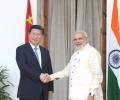
With the continuing stand-off in Ladakh casting a shadow over the Sino-India talks, Prime Minister Narendra Modi on Thursday raised 'serious concerns' over the repeated incidents along the border and sought an early settlement of the boundary question.

'It is unrealistic to expect that security dilemmas and strategic distrust to disappear or even diminish any time soon,' says Rup Narayan Das.

'It will make good sense for military men on that side of the table to be confronted by our own.'
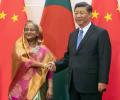
'Beijing is comfortable with Hasina's pragmatism -- perceived as 'pro-India', but staying out of Indian orbit and receptive to forging close ties with China and yet, siding with neither neighbour,' says Ambassador M K Bhadrakumar.
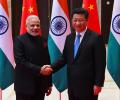
It would be a chance lost if India cannot learn from and lean more on China to kick-start trade, infrastructure programmes, and increased ties, says Ravi Agrawal

Khan's visit evoked considerable interest in Beijing as it comes in the wake of his past criticism of the USD 50 billion China-Pakistan Economic Corridor projects and remarks by his ministers to cut down some of the projects over debt concern.

Prime Minister Narendra Modi said he looks forward to useful conversations with his fellow leaders from China, South Africa, Brazil and Russia on addressing pressing international and regional challenges that stand in the way of their goals.

As the pandemic unfolded, the India-China relationship has come under severe stress. To restore normalcy, agreements between the two countries must be respected scrupulously in their entirety. Where the Line of Actual Control is concerned, any attempt to unilaterally change the status quo is unacceptable, declares External Affairs Minister Dr Subrahmanyam Jaishankar.

President Xi Jinping's visit may put relations between India and China on a new trajectory
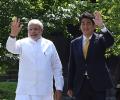
Although the India-Japan relationship has its own driving forces in terms of robust economic ties and shared values, China is the elephant in the room in the strategic parleys between the two countries, says Rup Narayan Das.

'China's excessive military aid to Pakistan is the real elephant in the room as far as Sino-Indian relations are concerned. India should be confident enough to accept a degree of closeness between China and Pakistan, since China may wish to use this link for its foray into the Muslim world.' 'But the Chinese must be realistic enough to know that as time passes, the tactic of using Pakistan as a proxy to check India will yield diminishing returns. The US tried it for 60 years but failed, so will China,' says Colonel Anil A Athale (retd).

It's a packed 5-nation, 9-day, visit for Prime Minister Modi as he heads to Uzbekistan, Kazakhstan, Kyrgyzstan, Turkmenistan and Tajikistan, apart from Ufa in Russia.

Important for Chinese President Xi Jinping will be Zhao's discussions on the issues of Tibet and the Dalai Lama and his assessment of the likely results of India's coming national elections, notes former senior RA&W officer and China expert Jayadeva Ranade.

'The intrusion in Chumar, during and beyond the Chinese president's visit, is unprecedented and has qualitatively changed the tone of the India-China relationship,' says Jayadeva Ranade, a member of the National Security Advisory Board.

The two countries also asked all nations to stop cross-border movement of terrorists and asserted that a decisive collective response from the international community without 'double standards and selectivity' was required to combat the threat of terrorism.

Claude Arpi gives a fascinating firsthand account of the Dalai Lama's arrival in Tawang in March 1959 and explains why he will once again receive a grand welcome, whether Beijing likes it or not.

The agreement on services, if ratified by all member countries, could prove to be a game changer for Indian professionals in education, healthcare & IT.

The decision to not attend the forum attended by 28 heads of state and 130 national delegations is a clear break from its usual policy of going along with the crowd.

'New Delhi showed itself willing -- at least for a period -- to tolerate the risk of conflict and to withstand Beijing's implicit and explicit threats.' 'But it also continued to try to cut some kind of deal with China to reduce tensions.'

'Xi Jinping got a dose of Modi's medicine inside the tent where he was being hosted on the banks of the Sabarmati river.' 'Modi reportedly told him, looking deep into his eyes: "This was not expected of your country. Can you tell me when the troops are withdrawing?".'

The expulsion is likely to cloud India-China ties as Narendra Modi visits China for the G-20 Leaders Summit on September 4-5 and Xi Jinping is scheduled to be in Goa for the BRICS meeting on October 15-16.
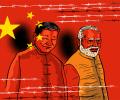
'Given the sharp increase in oil prices, a mounting problem for the 2nd and 4th largest importers like China and India -- the Qingdao meeting is likely to push for the large energy producers (Russia and the Central Asian Republics) and energy consumers (China and India) to arrive at some understanding for mutually beneficial outcomes,' notes Srikanth Kondapalli.
Talking about the threat of terrorism, he said "As diverse and pluralistic societies, we both face threats from fundamentalist terrorism. Yet, we do not seem to be able to cooperate as effectively we should in some critical international forums dealing with this subject."

The India that needs strategic alliances, defence cooperation and engaging meaningfully with neighbouring countries is quietly moving ahead with confidence, says Tarun Vijay

India and China have not ruled out a Modi-Xi meeting during the summit.

China on Monday said Indian Prime Minister Manmohan Singh's three-day visit from Tuesday is of great importance for deepening strategic partnership amid expectations that the two sides would sign some key pacts, including one to prevent incursions along the LAC.
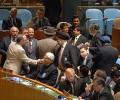
'Under Narendra Modi's leadership, we will be able to regain our rightful place in the community of nations,' veteran diplomat Hardeep Singh Puri, who joined the BJP on January 2, tells Rediff.com's Sheela Bhatt.

India is keen on the issue of equal share holding since it doesn't want a repeat of the distortions that have crept into Bretton Woods institutions like International Monetary Fund, World Bank and the Asian Development Bank in which rich countries like the US and Japan have a strangle hold.

President Xi said that the Chinese side is ready to work with the Indian side to carry forward the fresh impetus of bilateral relations.

As Myanmar sets out on a new path after decades of military rule, India on Monday promised whole-hearted support to it in "every step" of its journey as the two countries resolved to deepen ties and actively cooperate to combat terrorism and insurgent activities in the region.

'Happily,' says Ambassador B S Prakash, 'BRICS displayed new-found energy and built something real, a bank. Between needless nihilism and as yet unjustified euphoria, there are many stations for the BRICS train and we can watch its progress with renewed interest.'

In spite of irritants and hiccups in the relationship, a few deliverables are expected of the prime minister's visit to China, says Rup Narayan Das.

China on Monday opened the second land crossing in Tibet via Nathu La to allow the first batch of Indian pilgrims undertaking the arduous Kailash-Manasarovar Yatra, in the latest confidence-building measure between the two neighbours.

Four major political takeaways from Narendra Modi's much-anticipated trip to China

From early indications, the Modi government's foreign policy seems to be pragmatic and reciprocal, says K G Suresh.
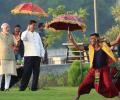
A sensational interview on India-China ties, with the man most qualified to answer.

'Young IFS officers today would take it for granted that they represent a major country with strengths and capabilities.' 'They will be aware that India is seen as one of the 10 significant countries in the world and therefore their voice will be heard whether on climate change or regime change,' says Ambassador B S Prakash.
 © 2026 Rediff.com - Advertise with us - Disclaimer - Privacy Policy - Sitemap - Feedback - About us - Terms of use - Grievances